
Auteur(s)
Mares Ann
Bron

Documentation sheet, Documentation Centre on the Vlaamse Rand, 2010

Organisatie
Documentatiecentrum Vlaamse Rand
Jaar
2010
Taal
ENG
Rand-abc fiche

Situation

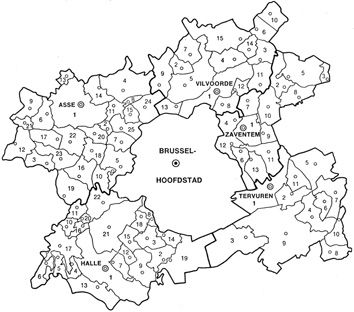
The Law of 26 July 1971 provided for the establishment of the Brussels conurbation and five surrounding arrondissements from the Border municipalities, namely the Border arrondissements of Asse, Halle, Tervuren, Vilvoorde and Zaventem. Due to the increased pressure caused by the language problems in the Brussels conurbation and the Border, a solution had to be found that gave these municipalities priority in the development of this new form of government, with the intention that the other metropolises of Antwerp, Liege, Charleroi and Ghent would follow. The intervention after all aimed primarily at rationalising and optimising the local government through expansion. The conurbation and arrondissements were respectively provided for urban and more rural regions, but both organisations are similar as far as structure, composition of the councils and powers are concerned. During the course of the 1970s, the solution to fuse the municipalities was finally chosen within the context of a better and more modern government, which made the Border arrondissements superfluous. While the Border arrondissements had already ceased to exist in 1977, the Brussels Conurbation Council was only abandoned after the establishment of the Brussels-Capital Region in 1989.

Map: Five Border Arrondissements around the Brussels Capital Conurbation
kaart randfederaties
Kaart: Vijf Randfederaties rond Agglomeratie Brussel-Hoofdstad
Composition of the five border arrondissements


ASSE BORDER ARRONDISSEMENT:
1. Asse
2. Bekkerzeel
3. Borchtlombeek
4. Brussegem
5. Dilbeek
6. Essene
7. Groot-Bijgaarden
8. Hamme
9. Hekelgem
10. Itterbeek
11. Kobbegem
12. Liedekerke
13. Mazenzele
14. Mollem
15. Relegem
16. Schepdaal
17. Sint-Katherina-Lombeek
18. Sint-Martens-Bodegem
19. Sint-Martens-Lennik
20. Sint-Ulriks-Kapelle
21. Teralfene
22. Ternat
23. Wambeek
24. Wemmel
25. Zellik
HALLE BORDER ARRONDISSEMENT:
1. Halle
2. Alsemberg
3. Beersel
4. Beert
5. Bellingen
6. Bogaarden
7. Buizingen
8. Drogenbos
9. Dworp
10. Elingen
11. Gaasbeek
12. Huizingen
13. Lembeek
14. Linkebeek
15. Lot
16. Oudenaken
17. Pepingen
18. Ruisbroek
19. Sint-Genesius-Rode
20. Sint-Laureins-Berchem
21. Sint-Pieters-Leeuw
22. Vlezenbeek
TERVUREN BORDER ARRONDISSEMENT:
1. Tervuren
2. Duisburg
3. Hoeilaart
4. Huldenberg
5. Leefdaal
6. Loonbeek
7. Neerijse
8. Ottenburg
9. Overijse
10. Sint-Agatha-Rode
11. Vossem
VILVOORDE BORDER ARRONDISSEMENT:
1. Vilvoorde
2. Beigem
3. Elewijt
4. Eppegem
5. Grimbergen
6. Hofstade
7. Humbeek
8. Machelen
9. Meise
10. Muizen
11. Perk
12. Peutie
13. Strombeek-Bever
14. Weerde
15. Zemst
ZAVENTEM BORDER ARRONDISSEMENT:
1. Zaventem
2. Berg
3. Buken
4. Diegem
5. Kampenhout
6. Kraainem
7. Melsbroek
8. Nederokkerzeel
9. Nossegem
10. Steenokkerzeel
11. Sterrebeek
12. Sint-Stevens-Woluwe
13. Wezembeek-Oppem
Table 1: General information on the Conurbation and Border Arrondissements
  population 1970 number of councilmen number of municipalities total hectare
Brussels Conurbation 1.071.094 83 19 16.179
Asse Border Arrondissement 106.949 27 25 18.934
Halle Border Arrondissement 102.575 27 22 18.078
Tervuren Border Arrondissement 47.787 19 11 15.259
Vilvoorde Border Arrondissement 97.787 27 15 13.468
Zaventem Border Arrondissement 63.832 23 13 8.584


Powers

The Border arrondissements were therefore cooperative partnerships between municipalities grouped around a core municipality. The following main technical powers belonged to these new, supracommunal governing bodies: the pick-up and processing of trash, the paid transport of persons, the fire brigade and urgent medical care. When the municipalities involved wished this for themselves, they could also arrange the following issues: airports, public markets, slaughterhouses, public car parks, tourism, camping, cremation and catacombs, establishment of services for technical aid for the municipalities and any other powers that were allocated to them by another government. More importantly was that the law on the conurbations and arrondissements also allowed for the possibility to transfer powers from the municipalities concerning the acceptance of general construction plans, advice concerning special construction plans, advice on district plans, and construction and subdivision ordinances to the arrondissement level. Like an emerald belt, the Border arrondissements around Brussels could thus participate in determining the spatial planning of the region. Even though the Border arrondissements were abandoned in the 1970s, their influence to this day is of extreme importance. After all, they form the foundation upon which many of the current intercommunal corporations have organised themselves, and furthermore, the construction ordinances of the previous Border arrondissement, limiting the number of floors to four, is still applicable in the municipalities that are within the region of the former Halle Border arrondissement.


The elections in the Border arrondissements on 21 November 1971

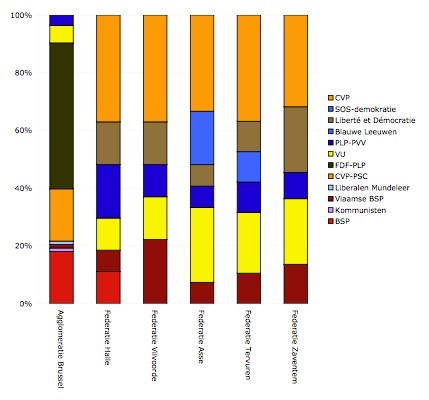
The Border arrondissements each have a directly elected council and an implementing tribunal. On 21 November 1971, the voters from the municipalities concerned were called together for the first (and only) election in the Border arrondissements. That same day, elections were held in the Brussels municipalities for the Conurbation Council. Because the elections were organised per municipality, the fear existed that the results, especially in Brussels and the facilities municipalities, would be interpreted as a sort of language count. In general, the results were a confirmation of the tendencies that appeared in the parliament elections of 7 November 1971; the Front démocratique des Francophones (FDF) and the Volksunie (VU) continued to pull votes away from the traditional parties in Brussels and the Border, respectively. In terms of language politics, the Border arrondissements were a Flemish counterweight to the radical French voice coming from the Brussels electorate. In the Border, the CVP lists received the most votes, but the VU lists also achieved equally strong results, as can be seen in the graph below. Proportionally, the CVP practically scored the same in the five arrondissements, but with results between 29 and 34% of the votes. The weight of the other political formations varied more strongly depending on the arrondissement. The arrondissements of Zaventem, Tervuren and Asse gave VU percentages of 21 and 23%. The French lists appeared in the Border under the name Liberté et Démocratie. They scored 21% of the votes in the Zaventem arrondissement.


Graph: Political composition of the councils after the elections of 21 November 1971
 

randfederaties grafiek partijen


The composition of the councils
With 43 of the 123 seats, the CVP was the strongest formation, but the biggest surprise was the Volksunie, which, with 23 seats, became the second largest party. The progress of the Volksunie with regard to the local elections of 1970 was striking in practically all the Border arrondissements. This Flemish nationalist party was already strongly rooted in a few of the municipalities, including Schepdaal, where Jef Valkeniers was at the helm of the division. The VU’s win was only limited in the Halle arrondissement due to competition with the strong Flemish CVP party leader, Renaat Van Elslande. Flemish voters responded to the francophone parties’ campaigns by voting for VU, which was, according to commentators, especially disadvantageous for the Red Lions (Flemish BSP) at the time. The Flemish socialists claimed third place in all the Border arrondissements together with 18 seats, coming in just before the FDF and Liberal lists (17 seats each). Moreover, the French liberals gained 4 seats in the Border arrondissement councils, and the PSC gained 1 seat.

The composition of the tribunals

The CVP also took the majority of the tribunal seats. They took the initiative in all five of the tribunals, and in all five of the tribunals, their candidate was the chairperson: for Halle: Jean De Kempeneer, Asse: Philip Vergels, Tervuren: Alfons Van Orshoven, Zaventem: Emiel Mennens and Vilvoorde: Leo Nauwelaerts. The installation of the arrondissement councils took place on 12 June 1972 and was linked with a few typical incidents during the taking of the oath. The Dutch Culture Council had however clearly enforced the Dutch formula as the only legal oath, but those elected from the Liberté et Démocratie lists ignored this decree. The elected official in Zaventem was also not sworn in. The response from a number of Flemish people present in Halle and Asse was to sing the Vlaamse Leeuw (Flemish Lion - the official anthem of Flanders).

Tabel 2: De zetelverdeling in de vijf Federatieraadscolleges na de verkiezingen van 21 november 1971

party Federatie Asse Federatie Halle Federatie Tervuren Federatie Vilvoorde Federatie Zaventem
BSP (Belgian Socialist Party)          
Kommunisten (Communists)          
Vlaamse BSP (Flemish Socialists)       1  
Liberalen Mundeleer (Liberals)          
CVP-PSC (Christian People’s Party)          
FDF-PLP (Democratic Front of the
Francophones - Party for
Freedom and Progress)
         
VU (People’s Union) 2 1 1 1 1
PLP-PVV (Party for Freedom and
Progress - Party for Freedom )
  1      
Blauwe Leeuwen (Brussels fraction
of the PVV)
         
PLP bruxellois          
Liberté et Démocratie   1   1 1
SOS-demokratie 1        
CVP 4 4 4 4 3
SCF ((branch of PSC)          
TOTAAL 7 7 5 7 5


Additional information


• Law of 26 July 1971 concerning the organisation of conurbations and arrondissements of municipalities (Belgian Official Journal, 24 August 1971), Download (PDF 412 Kb)

Publicatie type
Fiche
Categorie
Instellingen / wetgeving
Staatshervorming
Regio
Vlaamse Rand
Brussels Hoofdstedelijk Gewest
Share this